👁️
Monster
Canonical
Anamnesis
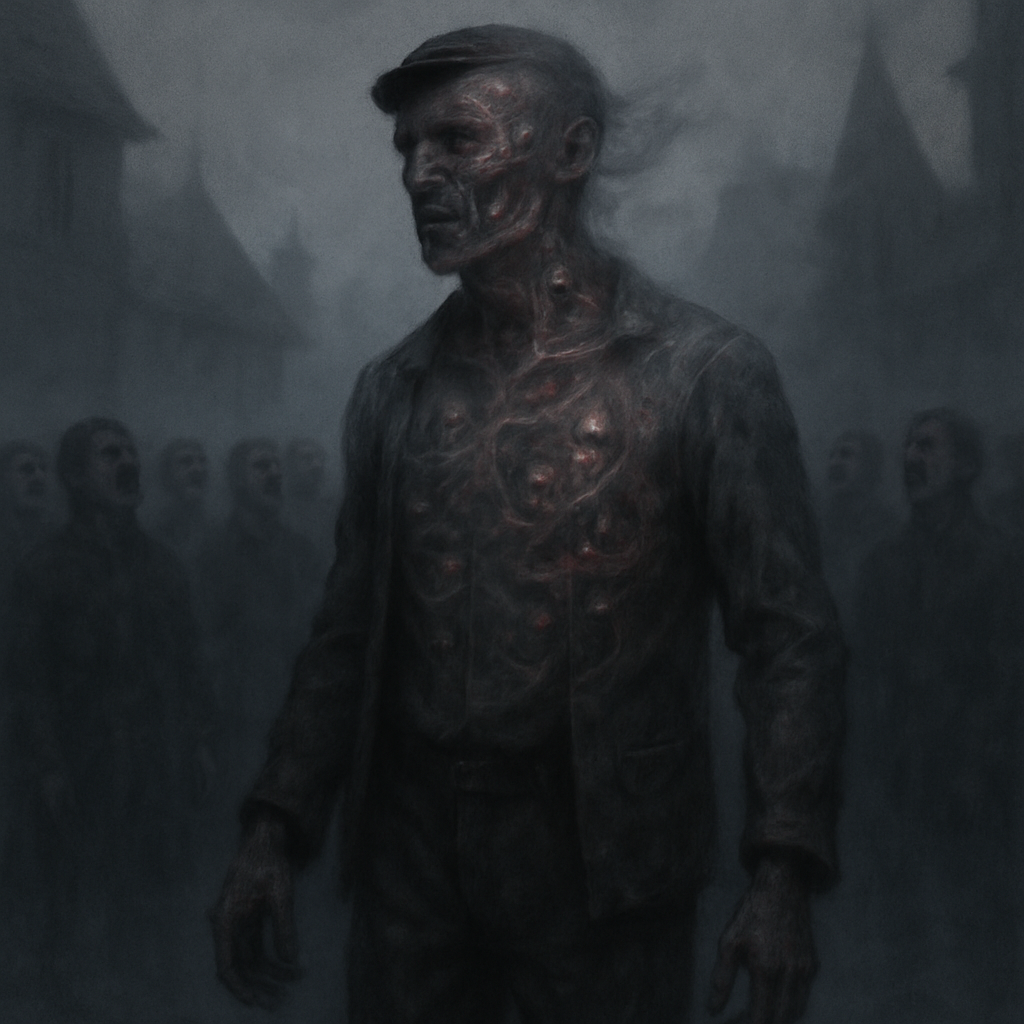
Anamnesis has no stable form of its own. In its true state it is a shifting mass of unfinished concepts: smoke trying to become lungs, rain trying to become blood, teeth forming and dissolving in open air, half-born voices, fractured memories, animal panic, grief, hunger, heat, ash, bells, and human faces that never fully resolve. Its raw substance constantly contradicts itself, collapsing and reforming in impossible combinations, so it cannot remain exposed for long. To survive, Anamnesis absorbs into a living being and uses that body as a focusing lens. The host appears mostly normal at first, but small errors give the truth away: delayed shadows, mismatched breath, wrong emotional reactions, a voice that arrives slightly before the mouth moves, or skin that seems to briefly contain smoke, rainwater, teeth, and flickering light beneath the surface. It does not simply possess the host — it concentrates itself through them, turning the body into the anchor point for its unfinished reality and radiating emotional pressure into everyone nearby. Anamnesis is born when a tear in the Pattern lets raw Drift substance spill into the world before reality can separate it into stable forms. It is not one memory, one emotion, one element, or one idea — it is countless incomplete things colliding at once: fear without a mind, hunger without a mouth, rain without clouds, grief without a name, voices without speakers, fire without heat, a person without a self. Unlike an Echo, which is one incomplete thought desperate to conclude, Anamnesis is too many incomplete conclusions trying to become real at the same time. It cannot finish itself, understand itself, or even decide what kind of thing it is. So it enters a living host. A body gives it boundaries, a name gives it shape, a mind gives it direction. Focused through a host, it forces the people around it into a shared state of fear, certainty, anger, devotion, or violence — turning a crowd into a single chorus. Every innocent death near it loosens the Pattern around that person's name, memory, fear, and final emotion, and Anamnesis consumes the rupture before reality can reclaim it, gaining more body, more voice, and more permission to exist. Where it appears, identity becomes contagious: crowds feel the same fear, villagers repeat the same phrase, families accuse outsiders in unison, and a town becomes a single mouth with one hidden thing speaking through it.
Battle Stat Block
Drop this creature into any quest — every value here is ready for the table.
Anamnesis
medium aberration (drift collision, host parasite), unaligned
Armor Class 14 (while hidden in a host; 15 revealed)
Hit Points 85 (11d8 + 33)
Speed 30 ft.
STR
10 (+0)
DEX
14 (+2)
CON
16 (+3)
INT
13 (+1)
WIS
15 (+2)
CHA
18 (+4)
Saving Throws WIS +5, CHA +7
Skills Deception +7, Insight +5, Perception +5
Damage Vulnerabilities thunder, psychic, force
Damage Resistances necrotic, poison, bludgeoning, piercing, and slashing from nonmagical attacks while hidden in a host
Condition Immunities charmed, frightened, poisoned
Senses darkvision 60 ft., passive Perception 15
Languages speaks through its host; understands any language known by creatures under its influence
Challenge 5 (1,800 XP)Proficiency Bonus +3
Hidden Host. Anamnesis begins combat hidden inside one living creature among a crowd of innocents. Until the players correctly identify the host, attacks against Anamnesis are made with disadvantage. The host looks like a normal townsperson, but careful observation reveals tells: it does not flinch when bells ring; its shadow moves half a second late; its breath does not fog in cold air; its voice arrives before its mouth moves; it repeats the mob's chant with one word wrong; other controlled townspeople unconsciously avoid looking at it; its emotional reactions don't match the situation; and if wounded it bleeds grey ash, black sap, rainwater, smoke, or tiny silent bells. A player may use an action to study the crowd and roll Insight, Perception, Investigation, Arcana, or Medicine; on a success the DM gives one true clue, and on a strong success narrows the host to two candidates. After three successful clues the party may confidently identify the host.
Emotional Chorus. Anamnesis controls nearby living creatures by forcing them into the same emotional state. Controlled townspeople share one initiative count and act as a mob. They are innocent and should not be treated as normal enemies. The mob may shove, grab, throw objects, block movement, restrain players, or defend the hidden host, but it fights without skill — like frightened people trapped behind their own eyes.
Feast on Rupture. Whenever an innocent creature under Anamnesis’s influence dies, Anamnesis gains 1 Feast Charge. Each Feast Charge grants +10 current and maximum HP, +1 AC (max +3), +1 damage to all attacks, and advantage on its next saving throw. At 3 Feast Charges it partially reveals itself; at 5 Feast Charges it fully stabilizes and becomes significantly more dangerous. Nonlethal damage does not trigger Feast on Rupture.
Borrowed Certainty. While hidden, Anamnesis may speak through any controlled townsperson; the voice is always calm, certain, and wrong. Once per round, when a player hesitates, accuses the wrong person, or harms an innocent, Anamnesis may force that player to make a DC 15 Wisdom saving throw. On a failure, the player has disadvantage on their next attack, check, or save made to identify or harm Anamnesis.
Revealed Form. When Anamnesis is correctly identified or reduced below half HP, its host body begins to fail: the face slips out of alignment, the skin stretches like wet cloth, and beneath it the players see raw Drift substance — smoke, rain, teeth, bells, ash, grief, heat, and fragments of other people's voices trying to become organs. Once revealed, Anamnesis can be targeted normally, it loses Hidden Host, the mob no longer attacks aggressively (though it may still block, stumble, panic, or shield it unwillingly), and Anamnesis gains access to its revealed actions.
Controlled Townsperson (Minion). Each controlled townsperson is a medium humanoid (innocent, controlled): AC 10, 8 HP, speed 30 ft., improvised strike +3 to hit for 1d4 bludgeoning. If a townsperson is killed, Anamnesis gains 1 Feast Charge. If reduced to 0 HP nonlethally, the townsperson collapses unconscious and does not empower Anamnesis.
Actions
Multiattack. Anamnesis makes two attacks: one Fractured Command and one Drift Lash, or two Drift Lash attacks if revealed.
Fractured Command. Each target must make a DC 12 Strength saving throw (up to two controlled townspeople within 60 ft.). shove or grapple resisted by a DC 12 save Hit: 1d4 bludgeoning (improvised; +1d4 vs. a prone or restrained target). Anamnesis forces controlled townspeople to act. Choose up to two controlled townspeople within 60 feet; each immediately makes one improvised attack (+3 to hit, 1d4 bludgeoning), shove, grapple (escape/resist DC 12), or object throw. If the target is already prone or restrained, the mob attack deals an additional 1d4 bludgeoning damage.
Drift Lash. Melee or Ranged Weapon Attack: +7 to hit, range 30 ft., one creature. Hit: 2d8 + 4 psychic or necrotic (+1 per Feast Charge). Anamnesis briefly unfolds part of its host body into raw unstable matter — the arm flickers into smoke, rain, teeth, and black thread before snapping back into human shape. Melee or ranged spell attack. If Anamnesis has at least 1 Feast Charge, add +1 damage per Feast Charge.
False Accusation. Each target must make a DC 15 Wisdom saving throw (one creature). On a success, the player hears the wrongness in the voice and gains advantage on their next check to identify Anamnesis. Anamnesis points at one player and speaks through the crowd. On a failed DC 15 Wisdom save, the mob focuses that player until the start of Anamnesis’s next turn: mob attacks against that player have advantage, and movement through the mob is difficult terrain for them.
Concept Split (Revealed) (Recharge 5–6). Each target must make a DC 15 Wisdom saving throw (each creature in a 15-foot cone). half damage and no distortion on a success Hit: 4d8 psychic. Anamnesis tears open briefly, releasing unfinished reality in a 15-foot cone. On a failed DC 15 Wisdom save a creature takes 4d8 psychic damage and suffers one temporary distortion until the end of its next turn: cannot speak clearly; cannot distinguish one ally from another; forgets what weapon or spell it intended to use; moves 10 feet in the wrong direction; or hears the mob chanting in its own voice. Only usable once Anamnesis is revealed.
Reactions
Hide Behind a Life. When Anamnesis is attacked while hidden or adjacent to a controlled townsperson, it may pull an innocent into the path of the attack. The attacker must choose: cancel the attack (wasting it); redirect the attack nonlethally into the innocent; or continue the attack and risk killing the innocent. Usable once per round. (While destabilized by psychic, thunder, force, or resonance damage, Anamnesis cannot use this until the start of its next turn.)
DM Notes
Tactics. Anamnesis does not begin as a direct combatant. It hides inside a townsperson and uses the mob to pressure, surround, restrain, and confuse the party, trying to make the players panic and kill innocents — every innocent death makes it stronger. The encounter goal is for players to realize this is not a normal mob fight: they must investigate, restrain, disable, and identify the true monster before using lethal force. Before any innocent dies, make it clear they are ordinary people under control (fear, tears, hesitation, human blood) so consequences feel earned. Counterplay: expose it through observation, bells, reflection, psychic/thunder/force damage, possession-revealing magic, emotional appeals to townspeople, or by tracking which person the mob unconsciously protects. Track innocent deaths — 0 killed: the town is grateful and helps; 1 killed: shaken but may understand; 2–3 killed: the town fears the party and withholds aid; 4+ killed: the party becomes part of Bellroot Vale’s horror and later enemies may speak in the voices of the dead.
Counterplay. Bell Weakness: a clear bell tone disrupts its stolen focus. If a bell is rung with intent, Anamnesis makes a Charisma save; on a failure Hidden Host drops for one round, controlled townspeople freeze, and players gain advantage on checks to identify it. • Reflection Weakness: if the host sees itself clearly in a mirror, polished steel, still water, or magical reflection, Anamnesis flickers visibly beneath the skin and the players immediately gain one clue toward identifying it. • Psychic / Thunder / Force Weakness: it is vulnerable to thunder, psychic, and force damage. Focused psychic, thunder, force, or resonance damage destabilizes its structure, and on being hit by one of these types it cannot use Hide Behind a Life until the start of its next turn. • Moral counterplay: it grows stronger from innocent deaths and weaker when the party refuses to kill — restraining, disabling, and freeing the mob starves it of Feast Charges.
Designed for ~~18–26 (one Fractured Command + one Drift Lash). Designed as a moral-deduction Controller encounter for CR 5 — the real pressure is the Feast on Rupture escalation and the risk of killing innocents, not raw damage. damage / round • controller
Why It Exists
What broke here
A tear in the Pattern near Bellroot Vale where Drift material leaked in faster than reality could stabilize it — most often near Shards, broken Anchors, failed rituals, mass deaths, or a place where many people felt the same overwhelming emotion at once.
What leaked through
Not a single monster but a collision — an impossible knot of raw elements, emotions, memories, instincts, and unfinished identities that can only survive by borrowing a living shape.
Drawn to
Crowds and shared emotion, and above all death. It is pulled toward grief, fear, certainty, devotion, and the loosening of the Pattern that follows each innocent death near it.
Details
Created by:MarcMercury
Created:June 17, 2026
Updated:June 17, 2026
Canon StabilityAbsolute (100%)
Appears In Stories
No stories reference this entity yet. This part of the world awaits its chronicler.